
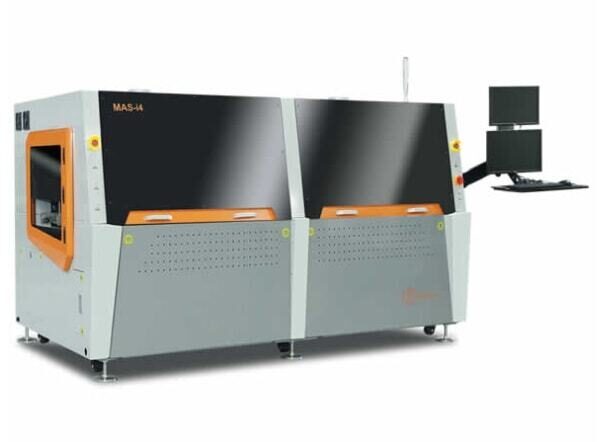


MAS-i4 Questions and Answers
What preheating system does the MAS-i4 use?
Top: IR (soldering zone) and forced convection (preheat zone); Bottom: IR preheating. Comprehensive preheating ensures consistent thermal profiles for reliable solder joint formation on demanding lead-free alloys.
What are the N2 requirements for the MAS-i4?
~6 m³/h total consumption at >99.99% purity. SASinno recommends the SelMate-8 N2 generator as the optimal pairing for these requirements.
What are the installation requirements for the MAS-i4?
Power: 3PH 220V 60Hz; Air: 3–5 bars; Exhaust: 800 m³/h; Footprint: 3,360mm (L) × 1,750mm (W) × 1,650mm (H); Weight: 1,800 kg; Max power: 25 kW .
What PCB dimensions and weights can the MAS-i4 handle?
Conveyor width: Max 510mm; Solder pot capacity: 60 kg total (30 kg per pot). Clearances: Top 100mm, Bottom 35mm. Consult the specific chart for parallel vs. sequential board processing configurations.
What real-time quality monitoring does the MAS-i4 offer?
A live-on camera for observation, automated wave height calibration, and real-time process monitoring. All data is viewable via the Windows 10-based software platform.
What distinguishes the MAS-i4 from the MAS-i2 in a purchasing decision?
The MAS-i4 is designed for higher throughput with 4 total selective wave tunnels (2 per pot). It features a three-section conveyor for fixed-pathway processing and dual drop-jet fluxers, making it the priority for lines where throughput-per-hour is critical.
How does the MAS-i4 dual fluxer capability work, and why is it valuable?
Two German-made 1 L drop-jet fluxers come standard. This allows for applying two different flux chemistries in a single pass or halving cycle times on boards with high flux point density.
How are the MAS-i4 solder pots positioned, and can the distance be adjusted?
The two pots share a common X/Y table with independent Z axes. The Y-axis distance is software-adjustable; the wave distance is manually adjustable from 160 to 255mm.
What is the MAS-i4 four-wave-tunnel configuration, and how does it improve throughput?
Each of the two pots contains two individual selective wave tunnels. This allows the machine to solder multiple joints simultaneously per board pass, significantly reducing cycle time compared to single-pot systems.