
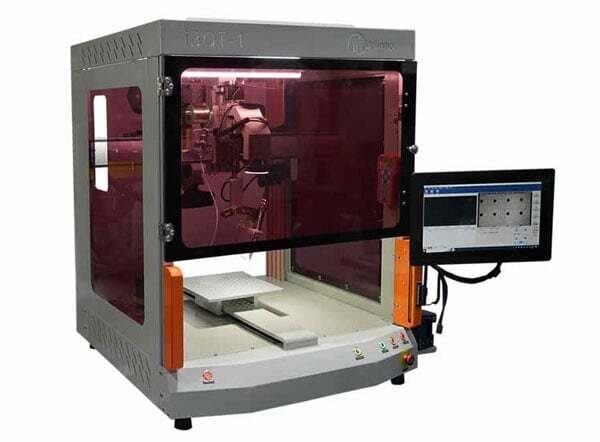


iBot-1 Questions and Answers
What soldering station does the iBot-1 use?
A 250W JBC high-power station (R470 type) with direct heating. The high wattage enables rapid tip recovery, maintaining temperature (200–450°C) during high-thermal-mass soldering.
What iBot-1 automatic maintenance features reduce operator intervention?
Automated wire feeder and automatic tip cleaning at programmed intervals. These prevent contamination and reduce tip replacement frequency.
How does the iBot-1 CCD path teaching system work?
It captures the PCB image to identify fiducial markers, automatically correcting for offset misalignment. This enables ~10-minute program setup for new board types.
What is the machine travel range for the iBot-1?
X: 430mm; Y: 420mm; Z: 80mm; R: 320° . Max speed is 500 mm/s with a 5 kg platform load.
What is the iBot-1 "break tin" solder wire feeding system?
It pierces the wire to reduce burst tin residue and achieves 0.1mm feeding accuracy. Standard wire size is 0.8–1.2mm.
What are the environmental and installation requirements for the iBot-1?
Ambient temp: 0–40°C; Air: 0.4–5 kg/cm²; Weight: ~150 kg; Footprint: <1m × 1m .
How does the iBot-1 handle PCB position variation between boards?
The CCD system identifies fiducials and applies an offset correction automatically. This eliminates the need for precision fixture alignment on every board.
What is the fundamental difference between the iBot-1 and iBot-2?
The iBot-2 adds a second independent Y axis for dual separate working zones. While soldering on one table, the operator loads/unloads the other, eliminating idle time.
What solder wire sizes and tip types are compatible with the iBot-1?
Standard wire: 0.8–1.2mm; JBC R470 type tips with various geometries. Custom tips are available for unique requirements.
What is the ROI case for replacing hand soldering with the iBot-1?
Consistency, continuous uptime, and quality (elimination of cold joints). ROI is usually achieved within 12–24 months.
What processes does the iBot-1 automate, and what were operators doing manually before?
It automates iron-tip soldering previously done by hand, such as wire-to-board or connector pins. It delivers ±0.05mm repeatability, eliminating operator fatigue and skill variability.